09 June 2015

Cahors Black Wine: A Brief History


The A.O.C. of Cahors has a fascinating history.  It was established in 1971, but winegrowing of Malbec goes back far beyond that.  In fact, its history in intertwined with Bordeaux:  the famous appellation used to buy "black wine" from Cahors to mix into its otherwise "weak" claret.

Here is the beautiful Lot river.  All of the grapes are grown along the river, with the lesser vines in the valley and better ones on plateaus with higher elevation alongside the river.  The vines grown on the valley floor are more fruity, basic, and less expensive; mid-level terraces are richer and more elegant.  The plantings farthest away from the river on plateaus, which are less fertile, higher elevation, and higher acid, make the most finessed, ageable wines of the best quality.  The river also provided Cahors with a way to move the juice easily so it could be sold.This river helped Cahors become a viable appellation, after all.

You see, the reason Bordeaux had such a profitable life early on was because it was along 2 rivers that empty out into the ocean and are a short trip to England, where it could be sold at a premium price.  The Lot River heads straight toward Bordeaux, so growers centuries ago had a great audience.
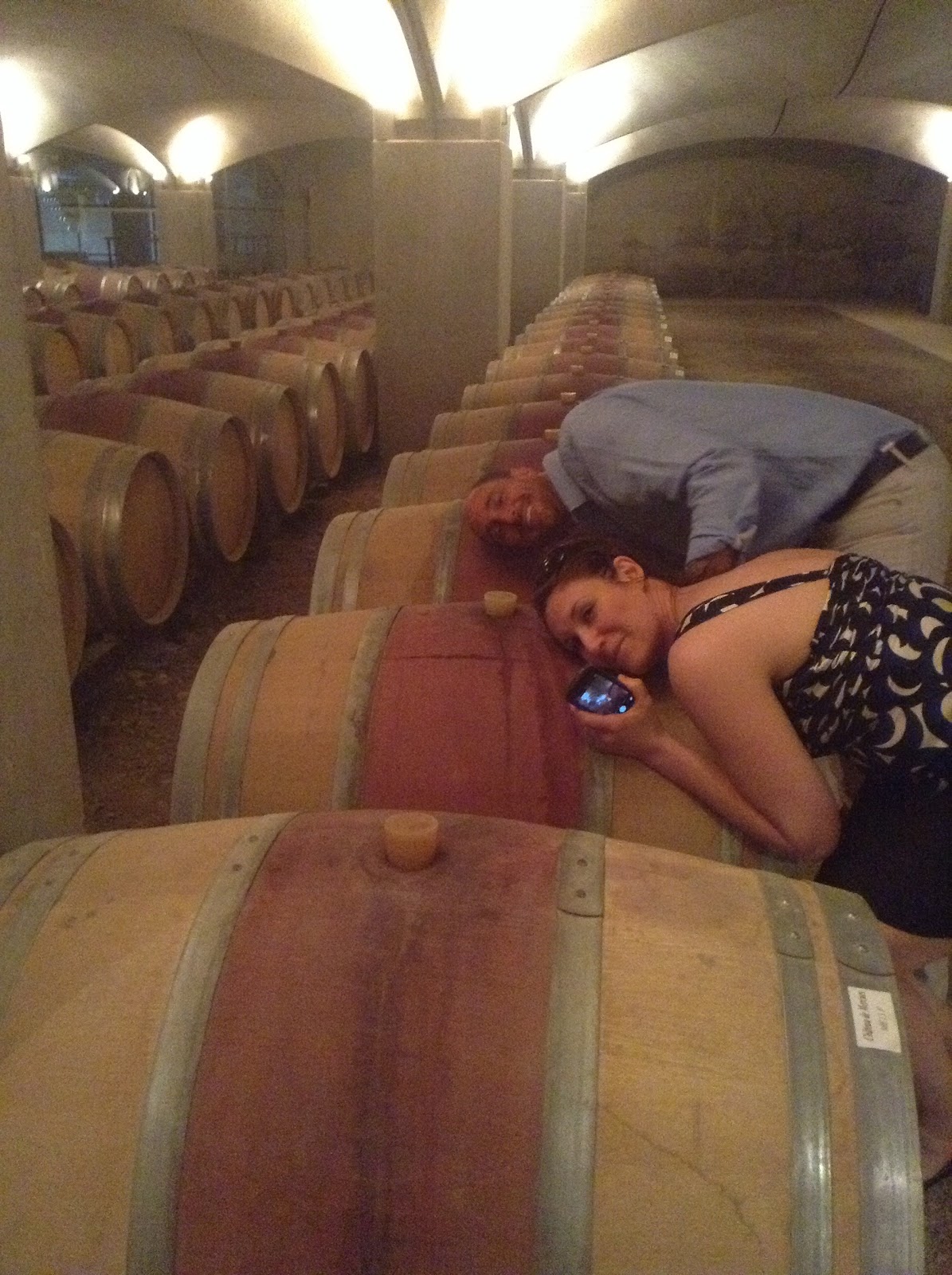
Chateau Haut-Serre's barrels.  Did the kings, popes, and tsars who loved Cahors so much listen to fermentation too??  These wines have been famous since the Middle Ages.
We are waiting for a Quercy (Cahors area) style buffet.  Which is largely consisted of foie gras and truffles, the 2 other things the area's known for.
But the area is best known for the wine.  Cahors, far from surpassing Bordeaux as a region, has been growing wine before the birth of Christ.  Its height of popularity was during the Middle Ages, and events like the week I attended have the express mission of putting Cahors back on the world stage.
Click HERE for a map of the AOC of Cahors in map form showcasing the terroir if you would like a geological reference.  For a historical reference, check out an induction of several sommeliers from the Northeast US into an ancient group that swears to uphold the standards of the land of black wine.
So, what is the region like today?  For starters, 90% of the plantings are Malbec.  Now, to claim the wine as Cahors, the wine only has to be 70% Malbec, with the remainder a blend of Merlot and Tannat (talk about another black wine!)  A whopping 80% of the vines are from independent growers!
Cahors went through many crises that should have shut down the entire appellation.  It is isolated by rivers and mountains from other regions within France, for a start, which provided a lack of integration.  More notably, phylloxera almost killed off the wine business.  In 1956, a severe frost coupled with negative-20 degree weather did a number on the crops.  And the French government taxes Cahors at a higher rate than the popular Bordeaux.
But the Quercy press on.  Here are some ancient vines at Chateau Cedre.  The DNA in Cahors is one of the most consistent in viticultural history.
The levels in Cahors have a lot of different factors, but the better the wine, these factors change: percentage of Malbec, longer ageing times, years the wines will last, and compatibility with food.  When some or all of these factors come into play, the price is higher as well.  One of the flagships in Cahors of better wines is higher density of soil, which is the lesson we are learning from an oenologist (above) and are seeing in the end product (below).
Though the fertile lowlands are great for crops such as vegetables, the plateaus are greatly preferred to grow high quality Malbec grapes.
The Lot sure is pretty.  By the way, Bordeaux folks did not make trade easy.  It took 3-5 months for grapes to get to Bordeaux by boat, and the wineries there were extremely focused on selling their own wines, rather than Cahors.  
As early as 1785, Malbec itself was mentioned as a varietal in a wine text.  Unfortunately, this region has a lot to overcome in the modern age to become viable once again, though Malbec is now famous in its own right.
Luckily, the region has proven itself resilient through what it has endured in the past, and will surely move on to a successful future.


08 May 2015

The land of foie...or "how would you like your liver today??"

I was invited last summer to Cahors Malbec Days, a celebration of all things from the land of Black Wine.  This is an international conference where we sat through endless seminars to educate sommeliers the world over about Cahors's place in history and the world scene of Malbec. 


But enough about that.  Right now, I'm going to talk about Foie Gras.
 Here is the first thing that I had upon my arrival in France (save the terrible whiff the minute I stepped off the plane of thousands of Frenchmen puffing cigarettes... seriously, is there anyone in this country that doesn't smoke)--some amazing nonsense of mushrooms with foie and egg on top.  Yummo!
You want more foie gras, you say?  Well, here you go. A friend from California (it was illegal there at the time) went to town!  Foie! Foie! Foie! (p.s. this link is how it can be ethical)
 It turns out that Cahors is known for two things:  1.  It is where Malbec originated  2.  Same for the best liver you have ever had in your life. (above is exhibit A, from a wine dinner after our first big tasting)
 Exhibit B: My friend Jerry is not quite tired of foie.  I love that this winery accented our plate of delicious liver with a side of sausage and more sausage.
 This is my kind of picnic.  To be honest, it's at D'en Segur in Tarn, about a half hour outside of Cahors.  But we're still talking about a bunch of goose liver on the plates, so who's counting, right??
 We also had some fabulous gazpacho in Tarn--doesn't tomato juice rejuvenate your constitution after your fat cells triple in one week??  I believe it does--and if that doesn't take care of it, I GUARANTEE that Rose will!!
 Still hungry? Here is straight-up foie on toast, plus seared foie with grilled apples on pumpkin bread... and melon.  with PROSCIUTTO.  of course.
 Not enough gratuitous meat in this blog, you are thinking?  Here's one of our courses in an after-tasting wine dinner.  That would be prosciutto-wrapped foie gras, of course.  And Malbec sauce to boot (we were a little overwhelmed with both liver and Cahors Black wine by now, but we tried to eat/drink it all.
 I've decided that this blog should be renamed "why Emily Garrison is not a size four."  And I will never have to explain why.  This luncheon had salad next to our foie gras pate!!! I was beside myself.
 Gratuitous meat shot.  The "sushi" was wrapped in ham. Go France!
 Maybe my favorite application of a whole lobe of foie gras ever.  Sliders!!!  At this point you might think, "are you kidding me??" Yeah, that's what I said too.
And finally, what would a salad be if it didn't have Serrano ham and Foie on top of it?  No more worries about those lunch salads having too much fat in the dressing, ladies!  Welcome to the land of the big, fat, juicy liver!  I myself was gorging on french fries.  Don't judge.  They certainly don't in Cahors.

Next week I'll actually discuss the wine we were there to study in France!!

Cheers,

- Emily Garrison, Shiraz Fine Wine & Gourmet

01 May 2015

McLaren Vale Australia--Wits End

One of my favorite wineries in McLaren is Chalk Hill--called Wits End here in the USA.  Jock Harvey's parents founded it and he and his brother Tom are now in charge; Jock made a name for himself as a fantastic vineyard manager and takes care of most of the prize vines in the valley.  They don't have a tasting room, and the cellar door is by appointment only (it pays to know the family!)

Wits End has had enormous success here at Shiraz.   Our best sellers are Procrastinator and Sidetrack, shown here with the Australian labels.  Hard to forget the name Procrastinator, though!  Wits End changed importers and I'm pleased to say they are now with Little Peacock.  I'm working with that company to bring the wines into the state of Georgia.


 Here are some of the other wines in the lineup--I'm in love with the Vermentino almost out of range on the left.  Yummy stuff with some serious pedigree.  Some of the oldest vines in the area belong to this small family winery.
 

a night out in McLaren... all the food here is so fresh!
 And here is the McLaren Farmer's Market.  It's one of the busiest places in town, and the options are wonderful, varied, and used by all the restaurants in the area.  I did major souvenir shopping here...

Jock's family was visited by a magpie and they have basically adopted it.  It is a talkative little guy,  
and hangs around waiting to be fed and petted!  I got 3 different videos, it chatted so much!

 I visited Angove's, sitting on the edge of some of the
Chalk Hill property.  Like d'Arenberg, they are big
proponents of the Grenache grape.  They have an
Enomatic machine (like we have at Shiraz)--they were
the first to get one in McLaren.  They are slated to add
another this year.  The view is tremendous!!


 Jock and I visited Samuel's Gorge  (winemaker Justin is right behind Jock--he is the one with the awesome hair).  This was a new winery for me, but everything they make is fantastic. Grenache, Tempranillo, Mourvedre, GSM... you name it, it was delicioius.  I look forward to seeing a lot more
from them in the future (and their greeter is precious).

Beautiful view at Samuel's Gorge... and beautiful Rose of GSM
 Two of my favorite treats from the visit:  delicious local lamb cooked by my dear friend Jock for a grand finale and a meat pie with a flat white--a sad meal because it was my last in Australia.

24 April 2015

McLaren Vale Day 1: d'Arenberg & Maxwell

 Welcome to McLaren Vale!!  It's yet another beautiful region within South Australia, and it is unique in that it is a Mediterranean climate.  A distinct difference from the massive, burly wines of the Barossa, and even more elegant than the cooler Clare Valley.  
It was an early vintage--most of the grapes have been harvested already, but the very late-ripening grapes are still on the vine.  And I mean late ripening.  Here is some Petit Verdot at Maxwell Wines.
Maxwell got its start with Mead way, way back.  They were actually responsible for introducing Mead to Australia, and remain the largest producer in the Southern Hemisphere.  They are equally renowned for their Shiraz, Merlot, and Cabernet.
Another very late-ripener:  Sagrantino.  With its Mediterranean climate, Italian varietals do very well.  SagrantinoSagrantino is a burly, tannic wine, so I was surprised at how delicious they are right off the vine.
This is Olivers Road--it comes off the main drag in town and connects Maxwell and d'Arenberg.
Maxwell also hosts an olive grove on the property.  In the future, look for a line of delicious oils!  (remember, it's a Mediterranean climate - which means that not only wine grapes grow well here)
I was lucky enough to enjoy a fabulous luncheon at the Verandah, one of my favorite restaurants.  Always a memorable stop, today Chester Osborn is speaking for a group of wine industry folks from the UK (and yours truly) sponsored by Wine Australia.

This was an extraordinary tasting:  instead of focusing on his own wines, Chester expounded upon the virtues of the valley he calls home.  We discussed the history or Grenache there: in the 1850s, it was mostly Grenache and Mourvedre.  Between 1900 & 1930 there was a Grenache boom because fortified wines were so popular in Oz; As dry reds had a resurgence, Grenache remained strong in the area.  There are almost 60 growers here, and though it is only 5% of McLaren's production, there is still a strong emphasis (it's 70% of what d'Arenberg makes!)  It has super low yields and is mostly dry grown and old vine.  It does well on the hilltops with shallow soil (Shiraz needs more water).
Speaking of history, d'Arenberg was established in 1912--a hundred-year-old winery seemed like an appropriate place to talk about the region as a whole.  d'Arenberg is beautiful.  I could actually hear the magpies chirping on the property.
Here was our study of McLaren Vale Grenache in different forms:
-Shingleback Red Knot GSM 2012
-Wirra Wirra Original Blend 2011
-Rosemount GSM 2011
-Chapel Hill Bush Vine Grenache 2011
-Rosemount Nursery Project Grenache 2010
-Willunga 100 Grenache 2010
-Willunga 100 The Tithing Grenache 2010
-d'Arenberg Derelict Grenache 2009
-d'Arenbert Ironstone Pressings GSM 2009


Chester was a great host of the valley.  My favorite quote of the day:  "Reputations take a long time to build; quality will always win out."
Thanks for the great history lesson and warm welcome, d'Arenberg!!
The food at the Verandah is amazing, and they do a fab job with pairings.  We had a Grenache-centric menu that started with rabbit roulade with panchetta and anchovy, radish/fennel salad, and a buttermilk mustard emulsion.

Pork belly, fig chutney, and local radicchio and fennel was next on the table.
What's better than a sweet dessert? Gruyere, local pears, walnut crisps, and truffle honey, of course!