11 March 2015

Dessert Wines at Kilikanoon, 2 Ways


I was privileged to work the end of the harvest at Kilikanoon.  Though I was technically there for the blending of Athena's first vintage, I did get to do a bit of cellar work--and witness the picking of some pretty special liquid gold from the Estate.  Today, we're picking Cane Cut Riesling!
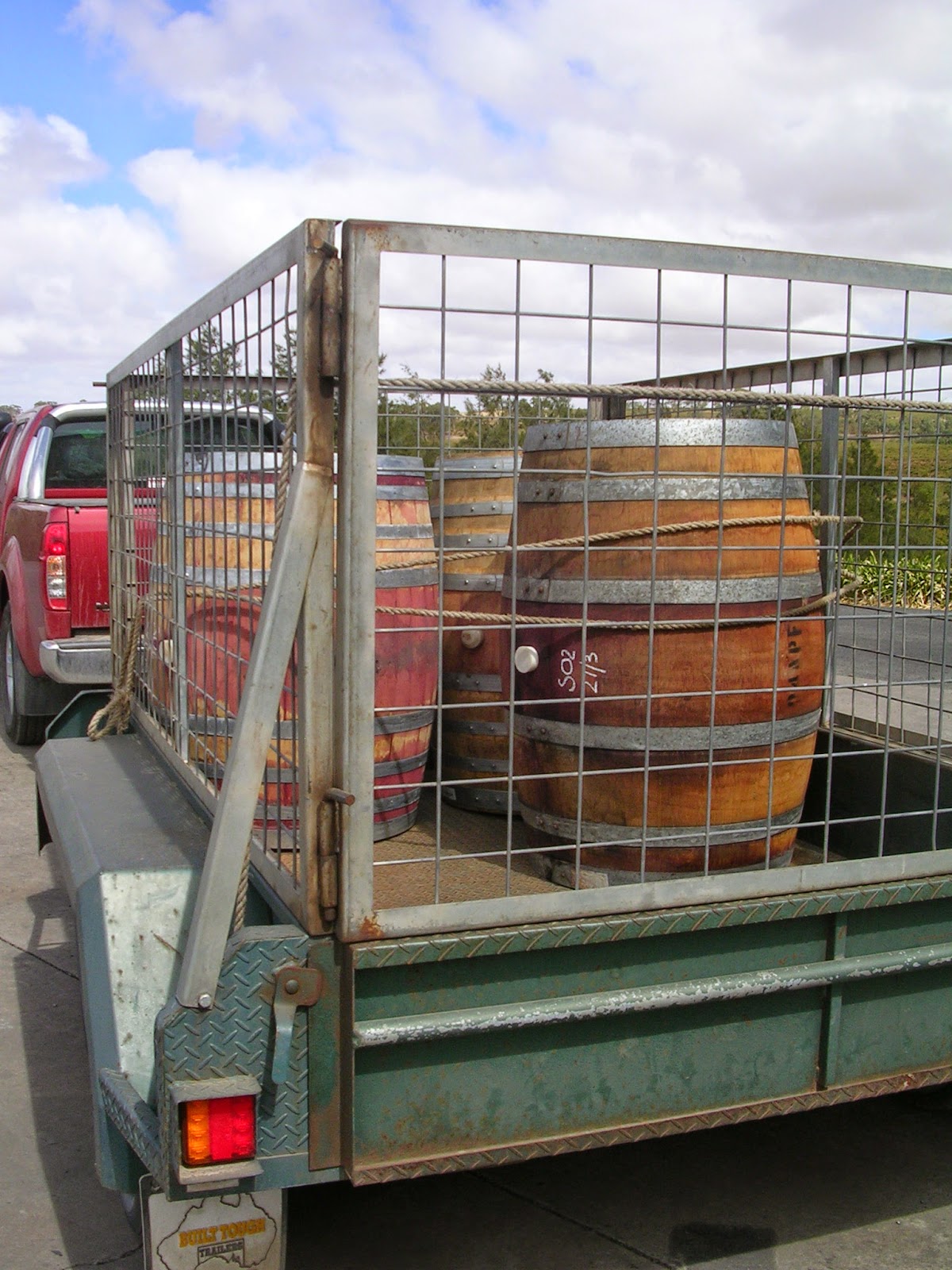

But first, let's discuss another sticky situation.  Kevin was about to create his very first fortified wine!  So far, the Cane Cut has been the only dessert offering from Kilikanoon.  This is naturally sweet (we'll get to that in a second) but this year offered up some exceptional Viognier (I tasted it in tank) but when the question was posed: "what do we do with this?" the answer was to add spirits from a company they deal with in the Barossa.  Kevin and I are hauling wine barrels there...


Here we are at the distillery.  Kevin and I tasted 3 kinds of additions:  grain alcohol, neutral spirits, and brandy.  I felt like Goldilocks.  One was too brash, one didn't have flavor... but the brandy was just right.  Unanimous decision.  The barrels were then left to have the spirit added and age with the beautiful wine to round out the flavor and stop fermentation before all the sugar is converted to alcohol.  Hello, sweet, golden lusciousness!  Can't wait to get my hands on it when it's finished.


Hard at work!!  Kevin, of course, our fearless leader, my hero, and Troy, vineyard manager.  Troy is about to take the workers out to get started on Kilikanoon's original sticky, Cane Cut Riesling.  Sometimes the term "cane cut" is a bit of misnomer (kind of like "old vines" since neither term has regulation) but Kilikanoon makes a TRUE style.  The canes (that feed water to the grapes) are cut when the grapes are at their ripest point, which makes the fruit dry up - any time you lose water, the sugars and alcohol levels are raised significantly.  This makes a dessert wine without adding spirits.


Here is what the Riesling looks like on the vine when it's super ripe.  You can see the patches of shriveled fruit amongst the big, fleshy bunches of "healthy" grapes that could make dry wine.


And here are some Cane Cut bunches--nothing but liquid sunshine and happiness here!

Here the guys are busy picking the grapes by hand - I stole away to "take pictures" (AKA eat a handful of delicious super-ripe grapes).  Most grapes don't taste very good off the vine (Viognier and Sagrantino are exceptions I've found) but these raisined Riesling nuggets are like eating candy! I basically slapped my own hand, reminded myself of how good this bottled, and took more pictures.

As you can see, everything is picked together in this vineyard.  They are fermented separately, though, to test for ripeness.  There's a specific sugar level that they're looking for so that the wine is sweet enough to qualify as a dessert wine without being cloying - Kevin is such a savant in the vineyard that he tasted the grapes and guessed a 50-50 blend of ripe and raisined grapes.  After measuring both sugar levels and figuring the levels in tank on both types, it was determined that the brilliant man in charge's guess was within .2 of the desired number.  This year was easy--simply blend everything together! (In an unripe year, for example, some of the ripe Riesling would be omitted from the blend to go into the Reserve dry style to keep the sweetness up in this one.)

Both were amazing creations.  Both rely on nature for the important part in the wine.  Delicious!!

21 January 2015

The makings of a great wine... In Clare Valley

Sometimes making wine is fun.  Like pumpovers.  It's great to smell the Shiraz as the air breaks through the cap, mellowing out those harsh tannins.  You really feel as if you're making great progress.  And then sometimes...

 SOMETIMES you have to scrub the walls of all the residue left from all that splashing around from the pumping over work. This is not fun. Or easy.
But after all that work, racking, pressing, pumping over, etc... You finally get to put that glorious juice in barrel, where you... Wait for a long time (here, a year minimum) before you get to see what the flavors start to evolve into.
Just another part of the process: I was fortunate enough to work with a PhD in the lab, testing wines and writing math on blackboards... It was a geek's dream!  Chemistry isn't exactly my thing, but cooking & Math I'm darn good at--so my instructor had me mix chemicals and do ratios, and I was pretty darn helpful.  I can follow formulas as long as it's just numbers, mate!
Here, we're measuring for temperature and solids.  We did pH and TA tests on wines as they were being made to make sure they were balanced and stable.

Yep. I LOVED this.
Anyone ever wonder what happens to all the by-product from winemaking? Well, the pomace (seeds, skins, stems-called must during winemaking) is a great fertilizer.  It's a great way to be more sustainable.  Another way to utilize waste?  Kevin and I head to the Barossa tomorrow to deliver a batch of this to make neutral grain spirit for Kilikanoon's first fortified dessert wine!

I just think wine going through the destemmer is sexy...
Here's another gratuitous shot.

And some juice. I didn't feel this post would make you thirsty enough...


I'll share more about actual blending coming up!  This is such a labor of love that it's invigorating being around masters in their work.  I hope I managed to relay a little of that passion!  Cheers!

04 November 2014

Kilikanoon Vintage 2013! Pressing Cab


Let me explain for a second how happy I was to even be able to be in this picture... I'm with two legends, Kevin & Mort Mitchell.  Way too privileged to be working with them both.  Overwhelmed.


I feel like this is just proof that I DID things and what-not.  Cleaning a tank.  Wearing a Kili shirt I made.  Kind of ridiculous, but it's all love.  For the record, I did work hard on this trip.  I'm cleaning the HELL out of this tank.  


I'm raking grapes out of a tank, which is harder than it looks.  At the end of this I realized I hadn't been so sore since... the last time I worked in the barrel room at Kilikanoon. Ugh.  You use some weird muscles to scrape these things out;  Best workout ever.


And after you scrape everything out with all you have, in it to win it, you have to grab things with your hands and just make it happen!  Those grapes have to be level to put them in the press!!!  So to make sure that the grapes are pressed correctly, here's how that goes...  I feel like I'm now legit.


Obviously, there's help needed in moving the press from the tank to the pressing apparatus.  Note the gorgeous sunset of wine barrels in the background.  We're about to make magic!  Cabernet looking pretty...


Money shot.  Fun to watch with the timer we've set:  an hour and a half for a press, for any of you who thought this happened quickly.  Kind of like cooking, slow and low means that you have more mellow flavor!  You can press quickly, but it's not the same.


And here's the juice--the  reason we're here.  The more we can get early run, the happier we are...


Sometimes you use fancy equipment, and sometimes you just need masking tape and a sharpie.  We put that Cab away in it's home for the next year.  Gonna be delicious.


Keep with us for more info about this vintage plus my wine I blended with Kevin.  This was a remarkable year for me in Australia!  Next, we pick some more grapes... 


13 August 2013

Riesling Road Trip, day 1 - Rheinhessen (and Tequila)

Off to the Rheinhessen! This area is diverse in their farming, with cows, wine, and grain as the major players in the agricultural scene. As a comparison, the Mosel's only crop is wine grapes. Between 1840 & 1860, Mosel suffered from poverty, where the Rheinhessen did not. While I applaud the various cash crops, I'm really only interested in what we're drinking, so we'll focus on that:

This morning we took a stroll around Wagner Stempel with Oliver, the vineyard manager. I knew I liked him immediately because he was wearing his "tractor pants" instead of a suit. I love people who focus on the dirt and not the fancy talk! Wagner Stempel has been around since 1845 and the current winemaker has been there since 1992. Fairly established, eh?? Most VDP estates are their size, at around 150,000 bottles a year (that's 12,500 cases for any non-math whizzes) 50% of what they grow and Oliver made it clear that "we drink DRY". (they have for 30 years).

Let's talk about the WS wines for just a second. They're awesome, for starters. But more specifically,they're dry but still full, organic, savory, and rich. Their style here is fruit-dominated with refreshing acidity and "just a kiss of wood." "Simple wine that's not simple." Can't say it better myself, so I won't. What I WILL say is that I was impressed by the spicy sleekness the wines showed. A fave of mine was the Weissburgunder (Pinot Blanc), the "red wine killer." Intense and concentrated, it's similar to a Grand Cru in style but not in price. It was like ambrosia,pineapple, and vanilla. . . followed by acid to cleanse the palate.

This was the road to the Nahe. Can't tell you how excited I was to travel to my favorite wine region in Germany! But first, can we talk about acid for a minute? After all, we Riesling fiends are called acidhounds for a reason...

p.s. Even the car parks in this part of the world are fantastic! Look at these beautiful flowers! About that acid...

Winemakers do not like to talk about deacidification, but isn't positive or negative--in super high acid years, it is a necessary thing to make the wine palatable. For instance, in 2010, all the wines had too much to begin with. Oliver said "so we had to deacidify in 2010; the French have to ADD acid EVERY year!" (funny, right? it gets better!) He ran into the supplier for citric acid in St Mauritz because the dude had such a great year selling the acid to Condrieu in 2011 that he went skiing!

This was a wonderful restaurant, Weck, on the way to the Nahe. It's named "Hermannshole" after a famous vineyard we'll see on the next blog, but for now, what a cute place, right?

We're about to have smoked salmon, herb creme fraiche, beef with mushrooms and potato cakes, along with Jakob Schneider Niederhauser Hermannshole Trocken (2010 in a mag, no less), but I digress... I promised a tequila story, after all.

Oliver also reminded us that dry extract (solids in wine) acts in an interesting way: it oscillates between acidity and salt in what it does to your brain (extract technically is sour). So the brain doesn't know which receptors are firing. This is, amazingly enough, why you can "pump down horrible tequila" because your brain has no idea if it's sour or acidic. You never know what you'll learn about drinking habits at 10 a.m.!

We took a moment to enjoy the scenery just outside the restaurant. I think we could have all stayed an extra 3 hours--but we need to get to Donnhoff, and Kruger Rumpf is next on my calendar!!!

Next on the blog will the the Nahe, with loads more info for you... here's the view on the road in between. With one missing picture: our cabbie explained about a seriously steep slope: "here's where people go to commit suicide." (us: whaaaat???? then: man, that was the best thing anyone's said this trip!!)
more to come, people!

- Emily Garrison, Shiraz Fine Wine & Gourmet

23 June 2013

German VDP Classification


The Germanicsystem defines its wine by sugar levels, ripeness, production and varieties.
Oechsle,which classifies the levels below, measures grape RIPENESS.
It's indicated by concentration of dissolved compounds in juice or must
since 90% of the dissolved solids in grape juice are sugars (plus acids, ions, and a host of other solutes) any measurement of these solids gives a indication of the grapes' ripeness, and therefore potential alcohol
**very important! 2 words: Trocken and Feinherb. Any wine can be dry if it is fermented all the way through to dryness. Therefore, a Spatlese Trocken is a dry, ripe, complex wine.

HERE IS A QUICK GUIDE TO RIESLING RIPENESS AND PROFILES:
-kabinett: light, slim body, low alcohol.
-spatlese: ripe, more complex.
-auslese: very ripe fruit.
-beerenauslese: very ripe fruit, with botrytis. (sweet)
-eiswein: very ripe fruit, no botrytis, from naturally frozen grapes, minus 7 C. (sweet)
-tba (trockenbeerenauslese): dried fruit, botrytis, sweet, honey. (sweet)
*0.13% of production in Germany is ba and tba.
*tba is the rarest of the german wines, not eiswein

Why is German wine complicated? Compare to Burgundy:
Côte d'Or: 5,500 hectares, 75% Pinot Noir, 25% Chardonnay
Germany: 102,000 hectares, 11 white & 17 red major grape varieties in 13 regions in 2 climate zones

VDPCLASSIFICATION MODEL OF 2012:
(with French counterparts and label examples)
1. VDP GROSSE LAGE
like Grand Cru
wines from Germany's best vineyard sites
dry wines are designated GROSSES GEWACHS
ex: Kiedrick Grafenberg GG Trocken
2. VDP ERSTE LAGE
like Premier Cru
ex: Kieddrich Turmberg Trocken
3. VDP ORTSWEIN
like Village
ex: Kiedricher Trocken
4. VDP GUTSWEIN
like Bourgogne AOC
ex: Rheingau Trocken
*GG is private predicate--the wineries decide what their best vineyards are.
Kabinett, Spatlese, etc. are predicates by law--Oechsle levels have requirements.
- Emily Garrison, Shiraz Fine Wine & Gourmet

Location:Rheingau, Germany

11 June 2013

Asian Flavours / German Wines

German wine and Asian food class with MW Jeannie Cho Lee

Gewürztraminer "goes with all chinese food" but it is one of the strongest profiles in the wine world, so not always!. Riesling works well, we know, but what about other wines to diversify options?

3 levels of pairing:
1. complementary (easier with european food because the flavor spectrum is narrower)
2. an accompaniment rather than an enhancement (*below)
3. contrast (like sweet with spicy chilis. tannins bring out more firey flavor)
*Taiwanese beef noodles or Peking duck - does wine make them more tasty? as compared to steak and potatoes .... the wine is good alongside it but it already has so many complex flavors on its own

Here's a typical Chinese menu: tofu; napa cabbage, abalone, sea cucumber, jellyfish, seaweed; tripe; chicken feet - different ingredients that all have umami. they have TEXTURE.
Umami is involved in sauces and broths, plus appreciation for textural components

*with asian foods you really have to take into consideration the condiments. palate sensation is affected. black bean sauce with noodles - with chicken or vegetables, the main flavor component is still the sauce.

Pickled veggies: they have a sharp vinegar note, so go moderate on the pickles when pairing with wine; sparkling wine is the savior for anything pickled. The finer the wine and more delicate the flavor the more you should back off of the pickles. "like a dance--don't have 2 dance partners who are leading" Find good accompaniments that will FOLLOW the lead of the sharpness--highest acid wine style you can find, it also cleanses the palate

With strong flavors, find a wine that doesn't try to be dominant (not too high alc or oak, fruity or young pn, soft pgr)
bbq meats without the strong flavors can pair with more mature, fine wines

Let's talk about salt--or lack thereof:
Asians use fish sauce, oyster, hoisin, soy--fermented condiments, not salt; they have umami that salt that doesn't have, plus depth and texture that is not added by salt alone
A very dry Pinot Blanc or Volnay style Pinot Noir--great for sashimi because it's about texture rather than about the fish.
Try this with salt and try with soy sauce.
Soy sauce will go much better with the Pinot Noir because it has more layers of texture than salt; if you use just salt it's better with the Pinot Blanc.
Think of wines that are all about the texture, for a fairly high umami content
Wines with longer lees contact will always have more umami content, so more barrel aging gives a way to bridge asian flavors.
(Spatburgunder--one of the most versatile red wines in the world)

If you have 12 courses and only 2 wines:
1 neutral white, 1 Pinot Noir. both from the beginning: Asian meals typically start with duck, goose, etc. Go from red to white. Common to go from heavy full strong--then to fish--all over the place. rhythm of the asian banquet is undulating volumes, not linear. (european is linear) asian goes in circles. diversity and contrast are better than something simple.

WINE COMPONENTS AND FOOD
a pairing guide:
*sweetness. late harvest etc: overwhelmes delicate dishes or umami richness. choose dessert or fatty dishes,
medium-sweet or off-dry wines with salty or spicy;
sweet wine with foie; moderately sweet is a good foil for hot or salty
*acidity: champagne, New Zealand Sauvignon Blanc, Italian whites, neutral Italian red, red or white Burgundy: crisp acid allows for versatility and balance with rich creamy, fatty, or salty; adds refreshment and cuts heat in spicy food while holding up well to sour/sharp notes
deep or stir fried foods work with sour ingredients because acid cuts through oil
*tannin/oak: Rioja, California Chardonnay, young Bordeaux or Barolo: complement red meat, fatty, grilled, rich stews.
grilled/bbq meat. With rich food. avoid spice. tannins work with protein and fat
*alcohol/body: Australian Shiraz, Amarone, Chateauneuf du Pape: overwhelm delicate flavor, exaggerate heat. not very versatile. heavy foods, rich with full flavor stand up.
maturity: 97 or older: highly compatible with the umami-rich. Refined, delicate dishes are best; avoid overly spicy or flavorful which overwhelm delicate nuances in mature wines. they have heightened umami flavors from bottle aging
*salty: soy, oyster sauce, shrimp/bean paste. accentuates tannins. soft tannins, crisp acid, and vibrant fruit are the answers.


- Emily Garrison, Shiraz Fine Wine & Gourmet

Location:Rheingau, Germany

19 May 2013

Geisenheim University classes!

Today, I went back to school! Geisenheim is where most of the Enology degrees in Germany originate, and we sat through a long and interesting day full of seminars. But first, we took a bus ride with the German Wine Queen (left) and the Rheingau Wine Queen (right)

I want one of these! Awesome large wine chiller with the white wines we are to taste during the seminars.

I loved this seminar! Jeannie Cho Lee, the only female Master of Wine in Asia, led a seminar on pairing German Wine with Asian food. I thought she was amazing. I took so many notes that I'll actually follow this up with a post devoted to the topic.

Professor Schultz, the Director of the University, gave us a talk on some of the advancements that they have been working on to improve the industry for the country. They've got a project right now to see how grapes will react to the increased C02 in the air with global warming. It's a FACE system (Free Air C02 Enrichment) can you see the picture on the top left? the FACE spikes surround a small patch of vines.


They are also developing robots to harvest grapes on the slopes too steep to use a tractor--which is a lot of them. It's becoming increasingly difficult to find people who want to do this terribly difficult work. The robot looks like a drum with spikes to dig into the ground. He had a great point: "the only way to maintain heritage is to use technology." The University was founded in 1872!)
One heck of a lunch buffet in the cafeteria!

Billy Wagner, a sommelier from Rutz Weinbar in Berlin, guided us through 16 different Pinot Blancs, Pinot Noirs, and Pinot Gris. He's also an expert on Riesling--his wine list has over 400!

This was a fun 6 hours of seminars!
Look for some info to come from the VDP classification chat.
- Emily Garrison, Shiraz Fine Wine & Gourmet

Location:Rheingau, Germany