01 May 2015

McLaren Vale Australia--Wits End

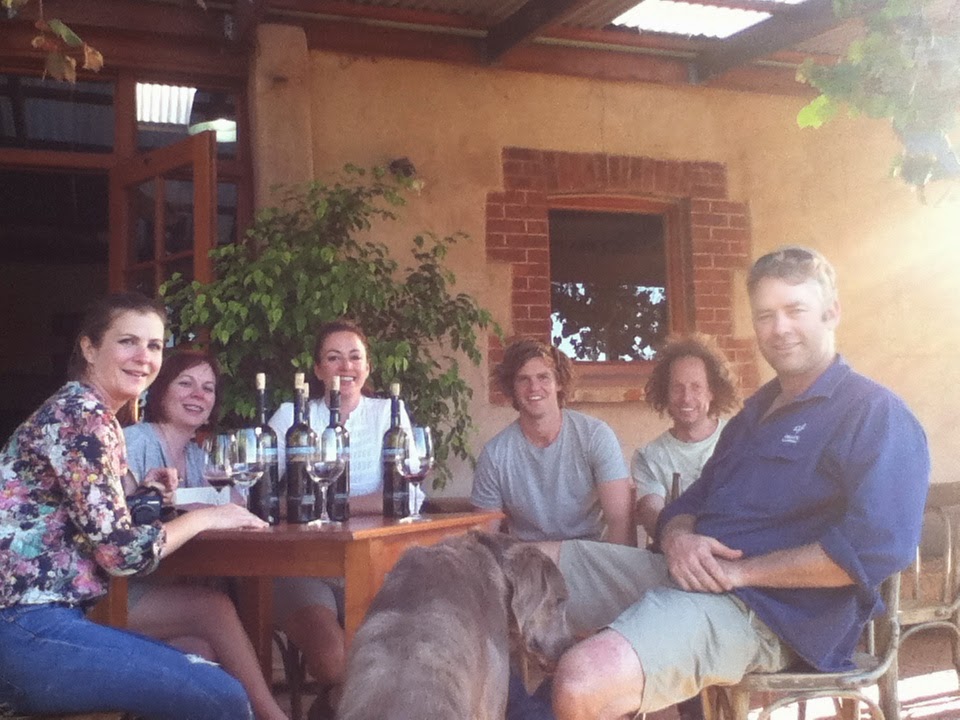
One of my favorite wineries in McLaren is Chalk Hill--called Wits End here in the USA.  Jock Harvey's parents founded it and he and his brother Tom are now in charge; Jock made a name for himself as a fantastic vineyard manager and takes care of most of the prize vines in the valley.  They don't have a tasting room, and the cellar door is by appointment only (it pays to know the family!)

Wits End has had enormous success here at Shiraz.   Our best sellers are Procrastinator and Sidetrack, shown here with the Australian labels.  Hard to forget the name Procrastinator, though!  Wits End changed importers and I'm pleased to say they are now with Little Peacock.  I'm working with that company to bring the wines into the state of Georgia.


 Here are some of the other wines in the lineup--I'm in love with the Vermentino almost out of range on the left.  Yummy stuff with some serious pedigree.  Some of the oldest vines in the area belong to this small family winery.
 

a night out in McLaren... all the food here is so fresh!
 And here is the McLaren Farmer's Market.  It's one of the busiest places in town, and the options are wonderful, varied, and used by all the restaurants in the area.  I did major souvenir shopping here...

Jock's family was visited by a magpie and they have basically adopted it.  It is a talkative little guy,  
and hangs around waiting to be fed and petted!  I got 3 different videos, it chatted so much!

 I visited Angove's, sitting on the edge of some of the
Chalk Hill property.  Like d'Arenberg, they are big
proponents of the Grenache grape.  They have an
Enomatic machine (like we have at Shiraz)--they were
the first to get one in McLaren.  They are slated to add
another this year.  The view is tremendous!!


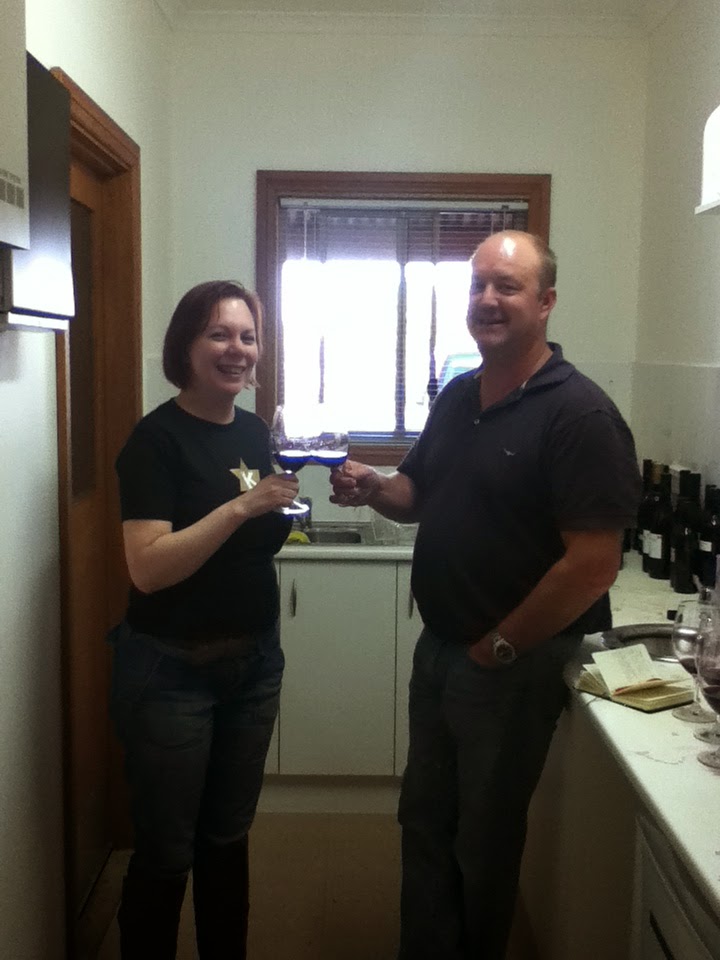
 Jock and I visited Samuel's Gorge  (winemaker Justin is right behind Jock--he is the one with the awesome hair).  This was a new winery for me, but everything they make is fantastic. Grenache, Tempranillo, Mourvedre, GSM... you name it, it was delicioius.  I look forward to seeing a lot more
from them in the future (and their greeter is precious).

Beautiful view at Samuel's Gorge... and beautiful Rose of GSM
 Two of my favorite treats from the visit:  delicious local lamb cooked by my dear friend Jock for a grand finale and a meat pie with a flat white--a sad meal because it was my last in Australia.

24 April 2015

McLaren Vale Day 1: d'Arenberg & Maxwell

 Welcome to McLaren Vale!!  It's yet another beautiful region within South Australia, and it is unique in that it is a Mediterranean climate.  A distinct difference from the massive, burly wines of the Barossa, and even more elegant than the cooler Clare Valley.  
It was an early vintage--most of the grapes have been harvested already, but the very late-ripening grapes are still on the vine.  And I mean late ripening.  Here is some Petit Verdot at Maxwell Wines.
Maxwell got its start with Mead way, way back.  They were actually responsible for introducing Mead to Australia, and remain the largest producer in the Southern Hemisphere.  They are equally renowned for their Shiraz, Merlot, and Cabernet.
Another very late-ripener:  Sagrantino.  With its Mediterranean climate, Italian varietals do very well.  SagrantinoSagrantino is a burly, tannic wine, so I was surprised at how delicious they are right off the vine.
This is Olivers Road--it comes off the main drag in town and connects Maxwell and d'Arenberg.
Maxwell also hosts an olive grove on the property.  In the future, look for a line of delicious oils!  (remember, it's a Mediterranean climate - which means that not only wine grapes grow well here)
I was lucky enough to enjoy a fabulous luncheon at the Verandah, one of my favorite restaurants.  Always a memorable stop, today Chester Osborn is speaking for a group of wine industry folks from the UK (and yours truly) sponsored by Wine Australia.

This was an extraordinary tasting:  instead of focusing on his own wines, Chester expounded upon the virtues of the valley he calls home.  We discussed the history or Grenache there: in the 1850s, it was mostly Grenache and Mourvedre.  Between 1900 & 1930 there was a Grenache boom because fortified wines were so popular in Oz; As dry reds had a resurgence, Grenache remained strong in the area.  There are almost 60 growers here, and though it is only 5% of McLaren's production, there is still a strong emphasis (it's 70% of what d'Arenberg makes!)  It has super low yields and is mostly dry grown and old vine.  It does well on the hilltops with shallow soil (Shiraz needs more water).
Speaking of history, d'Arenberg was established in 1912--a hundred-year-old winery seemed like an appropriate place to talk about the region as a whole.  d'Arenberg is beautiful.  I could actually hear the magpies chirping on the property.
Here was our study of McLaren Vale Grenache in different forms:
-Shingleback Red Knot GSM 2012
-Wirra Wirra Original Blend 2011
-Rosemount GSM 2011
-Chapel Hill Bush Vine Grenache 2011
-Rosemount Nursery Project Grenache 2010
-Willunga 100 Grenache 2010
-Willunga 100 The Tithing Grenache 2010
-d'Arenberg Derelict Grenache 2009
-d'Arenbert Ironstone Pressings GSM 2009


Chester was a great host of the valley.  My favorite quote of the day:  "Reputations take a long time to build; quality will always win out."
Thanks for the great history lesson and warm welcome, d'Arenberg!!
The food at the Verandah is amazing, and they do a fab job with pairings.  We had a Grenache-centric menu that started with rabbit roulade with panchetta and anchovy, radish/fennel salad, and a buttermilk mustard emulsion.

Pork belly, fig chutney, and local radicchio and fennel was next on the table.
What's better than a sweet dessert? Gruyere, local pears, walnut crisps, and truffle honey, of course!

08 April 2015

Blending Athena at Kilikanoon

Here's my account of the most important day during my work at Kilikanoon during the 2013 vintage!
We are making a GSM from the Clare Valley from 2012 juice; The Medley was Clare Valley fruit in the past, and the 2012 is going to be Barossa.  Which meant that I got to pick some pretty awesome wine to incorporate into a wine to showcase Clare and Kilikanoon!
This wine will hereafter be called Killerman's Run GSM, but I got to name the inaugural bottling:


This lineup is the Grenache available for the wine.  Kilikanoon barrels each vineyard picking separately (my preferred mode of transportation) so that decisions can be made much more judiciously down the road.  I've barrel tasted these during the vintage before, but this had more stress attached, since it's about to go into a bottle!!  Kevin and i first tasted through and picked out the top barrel (for The Duke) and the single vineyard tier (The Prodigal) -- once we'd taken the top two barrels, the world was my oyster.  There is some killer juice in this lineup!!  I had a hard time making a final decision, so I was forced to taste blind... and then it was easy! Yummy Grenache = done.


Here are our barrel samples of Shiraz available for the blend.  Head winemaker Katie had them all pulled for us--while the Grenache is aged for a year in stainless steel to preserve its freshness, the Syrah rests in French oak barrels for a year to allow a tiny amount of oxygen in, rounding and mellowing the wine.  We will put the wine back in oak for 6 months after blending to fully coax out the flavors and meld the 3 different wines together.  There will also be a single parcel of Mourvedre.


Hard at work, testing out all the individual parcels.  It's quite different, this tasting barrels as opposed to finished wines.  They are far more rough and rowdy than the finished product, but it's fun once you get used to how brash and intense they are.  It's like flexing a muscle to pop in and try some; imagining what they will taste like in 2, 5, 10, or 20 years is exciting and a task I appreciate honing.
I love our splatter of huge Shiraz sprinkled from our carefully measured 100 cl cylinders!


With the man himself.  This is after we had finally made the decisions of what was going to go into the bottle.  We had had to stop for a cold beer at some point because our palates were so tired--this was a 3 1/2 hour tasting session where the goal was to pinpoint minute differences in huge, gritty barrel samples of bold wine!  It was fatiguing.  And our lips were pretty black (no closeups please!)


I call this one "giddy exhaustion with my friend, mentor, and hero after a successful blending day"


Time for killer great pizza down the road--which tasted better than anything ever after this day...


Am I in Spain?  No. A pizza joint in the Clare Valley with awesome Kilikanoon employees.


And here's a wine I'd never seen before: Prophecy by Kilikanoon.  Because: Kilikanoon, of course.
Check out the '12 Athena where available! We made 500 cases, and 200 came into the USA.  It actually won the Decanter award for top Rhone blend under 15 pounds, proving once and for all that Kevin was looking out for me, making sure I didn't ruin it! And that the wine's in the vineyard.

11 March 2015

Dessert Wines at Kilikanoon, 2 Ways


I was privileged to work the end of the harvest at Kilikanoon.  Though I was technically there for the blending of Athena's first vintage, I did get to do a bit of cellar work--and witness the picking of some pretty special liquid gold from the Estate.  Today, we're picking Cane Cut Riesling!


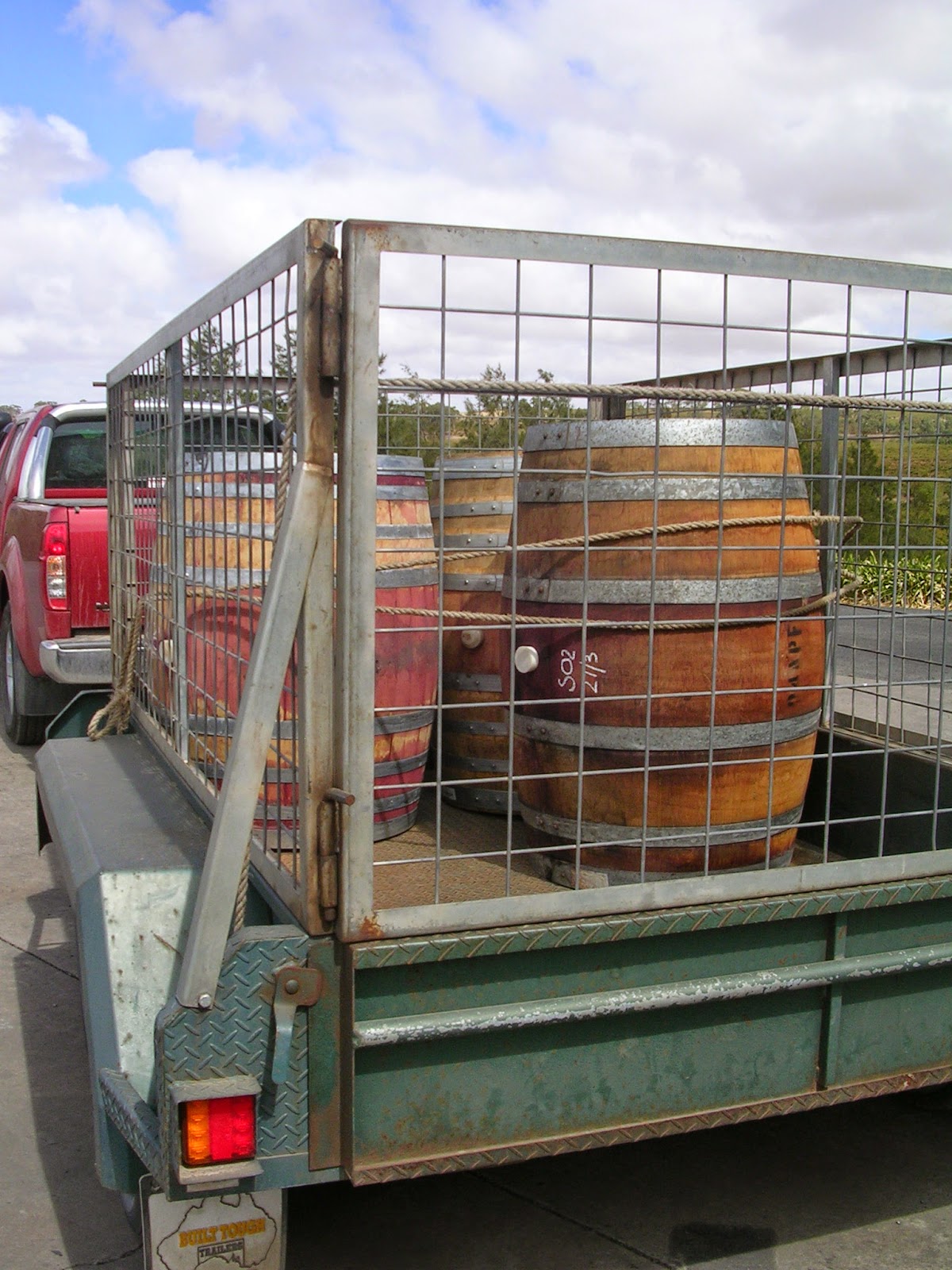
But first, let's discuss another sticky situation.  Kevin was about to create his very first fortified wine!  So far, the Cane Cut has been the only dessert offering from Kilikanoon.  This is naturally sweet (we'll get to that in a second) but this year offered up some exceptional Viognier (I tasted it in tank) but when the question was posed: "what do we do with this?" the answer was to add spirits from a company they deal with in the Barossa.  Kevin and I are hauling wine barrels there...


Here we are at the distillery.  Kevin and I tasted 3 kinds of additions:  grain alcohol, neutral spirits, and brandy.  I felt like Goldilocks.  One was too brash, one didn't have flavor... but the brandy was just right.  Unanimous decision.  The barrels were then left to have the spirit added and age with the beautiful wine to round out the flavor and stop fermentation before all the sugar is converted to alcohol.  Hello, sweet, golden lusciousness!  Can't wait to get my hands on it when it's finished.


Hard at work!!  Kevin, of course, our fearless leader, my hero, and Troy, vineyard manager.  Troy is about to take the workers out to get started on Kilikanoon's original sticky, Cane Cut Riesling.  Sometimes the term "cane cut" is a bit of misnomer (kind of like "old vines" since neither term has regulation) but Kilikanoon makes a TRUE style.  The canes (that feed water to the grapes) are cut when the grapes are at their ripest point, which makes the fruit dry up - any time you lose water, the sugars and alcohol levels are raised significantly.  This makes a dessert wine without adding spirits.


Here is what the Riesling looks like on the vine when it's super ripe.  You can see the patches of shriveled fruit amongst the big, fleshy bunches of "healthy" grapes that could make dry wine.


And here are some Cane Cut bunches--nothing but liquid sunshine and happiness here!

Here the guys are busy picking the grapes by hand - I stole away to "take pictures" (AKA eat a handful of delicious super-ripe grapes).  Most grapes don't taste very good off the vine (Viognier and Sagrantino are exceptions I've found) but these raisined Riesling nuggets are like eating candy! I basically slapped my own hand, reminded myself of how good this bottled, and took more pictures.

As you can see, everything is picked together in this vineyard.  They are fermented separately, though, to test for ripeness.  There's a specific sugar level that they're looking for so that the wine is sweet enough to qualify as a dessert wine without being cloying - Kevin is such a savant in the vineyard that he tasted the grapes and guessed a 50-50 blend of ripe and raisined grapes.  After measuring both sugar levels and figuring the levels in tank on both types, it was determined that the brilliant man in charge's guess was within .2 of the desired number.  This year was easy--simply blend everything together! (In an unripe year, for example, some of the ripe Riesling would be omitted from the blend to go into the Reserve dry style to keep the sweetness up in this one.)

Both were amazing creations.  Both rely on nature for the important part in the wine.  Delicious!!