24 April 2015

McLaren Vale Day 1: d'Arenberg & Maxwell

 Welcome to McLaren Vale!!  It's yet another beautiful region within South Australia, and it is unique in that it is a Mediterranean climate.  A distinct difference from the massive, burly wines of the Barossa, and even more elegant than the cooler Clare Valley.  
It was an early vintage--most of the grapes have been harvested already, but the very late-ripening grapes are still on the vine.  And I mean late ripening.  Here is some Petit Verdot at Maxwell Wines.
Maxwell got its start with Mead way, way back.  They were actually responsible for introducing Mead to Australia, and remain the largest producer in the Southern Hemisphere.  They are equally renowned for their Shiraz, Merlot, and Cabernet.
Another very late-ripener:  Sagrantino.  With its Mediterranean climate, Italian varietals do very well.  SagrantinoSagrantino is a burly, tannic wine, so I was surprised at how delicious they are right off the vine.
This is Olivers Road--it comes off the main drag in town and connects Maxwell and d'Arenberg.
Maxwell also hosts an olive grove on the property.  In the future, look for a line of delicious oils!  (remember, it's a Mediterranean climate - which means that not only wine grapes grow well here)
I was lucky enough to enjoy a fabulous luncheon at the Verandah, one of my favorite restaurants.  Always a memorable stop, today Chester Osborn is speaking for a group of wine industry folks from the UK (and yours truly) sponsored by Wine Australia.

This was an extraordinary tasting:  instead of focusing on his own wines, Chester expounded upon the virtues of the valley he calls home.  We discussed the history or Grenache there: in the 1850s, it was mostly Grenache and Mourvedre.  Between 1900 & 1930 there was a Grenache boom because fortified wines were so popular in Oz; As dry reds had a resurgence, Grenache remained strong in the area.  There are almost 60 growers here, and though it is only 5% of McLaren's production, there is still a strong emphasis (it's 70% of what d'Arenberg makes!)  It has super low yields and is mostly dry grown and old vine.  It does well on the hilltops with shallow soil (Shiraz needs more water).
Speaking of history, d'Arenberg was established in 1912--a hundred-year-old winery seemed like an appropriate place to talk about the region as a whole.  d'Arenberg is beautiful.  I could actually hear the magpies chirping on the property.
Here was our study of McLaren Vale Grenache in different forms:
-Shingleback Red Knot GSM 2012
-Wirra Wirra Original Blend 2011
-Rosemount GSM 2011
-Chapel Hill Bush Vine Grenache 2011
-Rosemount Nursery Project Grenache 2010
-Willunga 100 Grenache 2010
-Willunga 100 The Tithing Grenache 2010
-d'Arenberg Derelict Grenache 2009
-d'Arenbert Ironstone Pressings GSM 2009


Chester was a great host of the valley.  My favorite quote of the day:  "Reputations take a long time to build; quality will always win out."
Thanks for the great history lesson and warm welcome, d'Arenberg!!
The food at the Verandah is amazing, and they do a fab job with pairings.  We had a Grenache-centric menu that started with rabbit roulade with panchetta and anchovy, radish/fennel salad, and a buttermilk mustard emulsion.

Pork belly, fig chutney, and local radicchio and fennel was next on the table.
What's better than a sweet dessert? Gruyere, local pears, walnut crisps, and truffle honey, of course!

08 April 2015

Blending Athena at Kilikanoon

Here's my account of the most important day during my work at Kilikanoon during the 2013 vintage!
We are making a GSM from the Clare Valley from 2012 juice; The Medley was Clare Valley fruit in the past, and the 2012 is going to be Barossa.  Which meant that I got to pick some pretty awesome wine to incorporate into a wine to showcase Clare and Kilikanoon!
This wine will hereafter be called Killerman's Run GSM, but I got to name the inaugural bottling:


This lineup is the Grenache available for the wine.  Kilikanoon barrels each vineyard picking separately (my preferred mode of transportation) so that decisions can be made much more judiciously down the road.  I've barrel tasted these during the vintage before, but this had more stress attached, since it's about to go into a bottle!!  Kevin and i first tasted through and picked out the top barrel (for The Duke) and the single vineyard tier (The Prodigal) -- once we'd taken the top two barrels, the world was my oyster.  There is some killer juice in this lineup!!  I had a hard time making a final decision, so I was forced to taste blind... and then it was easy! Yummy Grenache = done.


Here are our barrel samples of Shiraz available for the blend.  Head winemaker Katie had them all pulled for us--while the Grenache is aged for a year in stainless steel to preserve its freshness, the Syrah rests in French oak barrels for a year to allow a tiny amount of oxygen in, rounding and mellowing the wine.  We will put the wine back in oak for 6 months after blending to fully coax out the flavors and meld the 3 different wines together.  There will also be a single parcel of Mourvedre.


Hard at work, testing out all the individual parcels.  It's quite different, this tasting barrels as opposed to finished wines.  They are far more rough and rowdy than the finished product, but it's fun once you get used to how brash and intense they are.  It's like flexing a muscle to pop in and try some; imagining what they will taste like in 2, 5, 10, or 20 years is exciting and a task I appreciate honing.
I love our splatter of huge Shiraz sprinkled from our carefully measured 100 cl cylinders!


With the man himself.  This is after we had finally made the decisions of what was going to go into the bottle.  We had had to stop for a cold beer at some point because our palates were so tired--this was a 3 1/2 hour tasting session where the goal was to pinpoint minute differences in huge, gritty barrel samples of bold wine!  It was fatiguing.  And our lips were pretty black (no closeups please!)


I call this one "giddy exhaustion with my friend, mentor, and hero after a successful blending day"


Time for killer great pizza down the road--which tasted better than anything ever after this day...


Am I in Spain?  No. A pizza joint in the Clare Valley with awesome Kilikanoon employees.


And here's a wine I'd never seen before: Prophecy by Kilikanoon.  Because: Kilikanoon, of course.
Check out the '12 Athena where available! We made 500 cases, and 200 came into the USA.  It actually won the Decanter award for top Rhone blend under 15 pounds, proving once and for all that Kevin was looking out for me, making sure I didn't ruin it! And that the wine's in the vineyard.

11 March 2015

Dessert Wines at Kilikanoon, 2 Ways


I was privileged to work the end of the harvest at Kilikanoon.  Though I was technically there for the blending of Athena's first vintage, I did get to do a bit of cellar work--and witness the picking of some pretty special liquid gold from the Estate.  Today, we're picking Cane Cut Riesling!


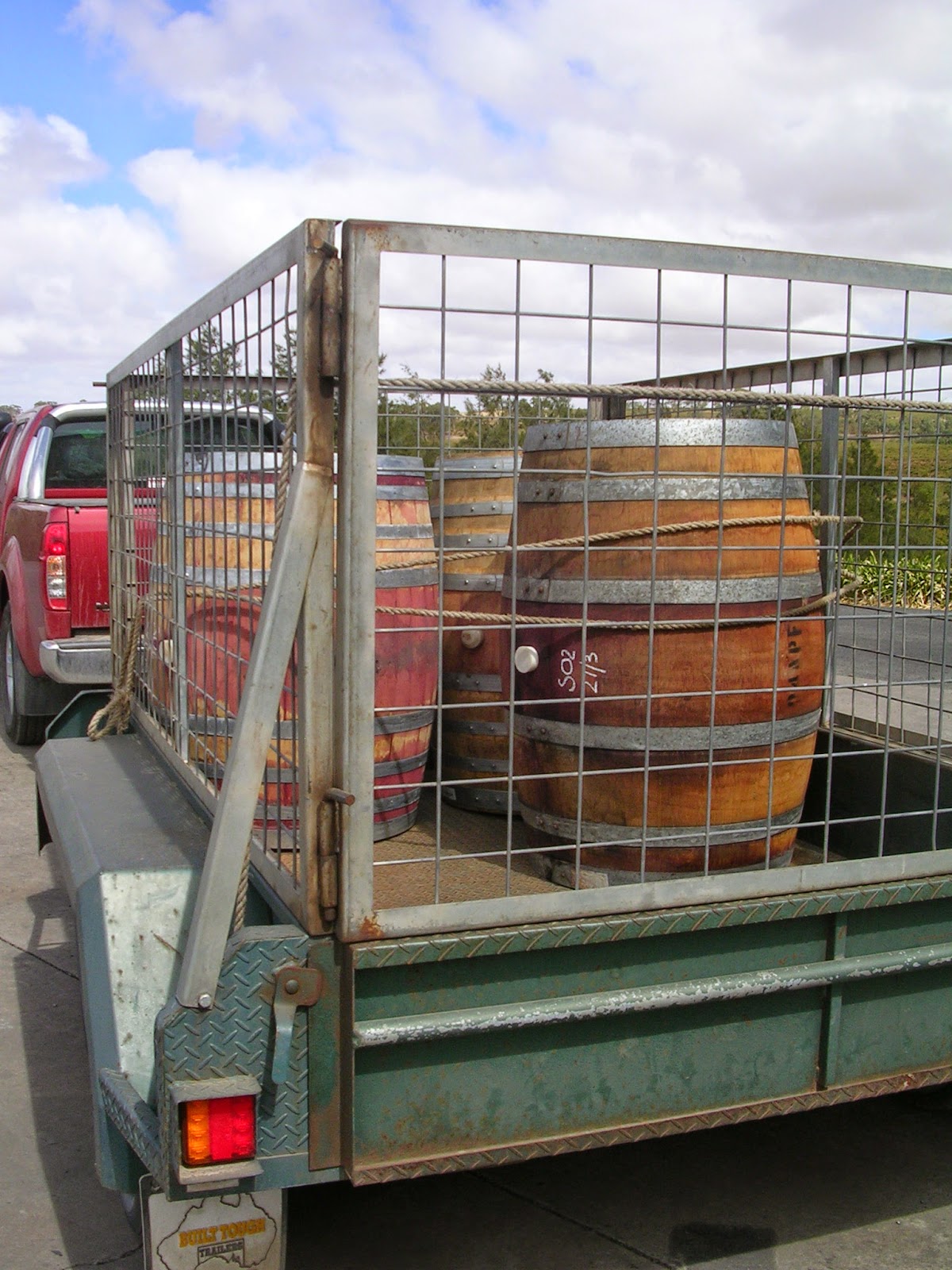
But first, let's discuss another sticky situation.  Kevin was about to create his very first fortified wine!  So far, the Cane Cut has been the only dessert offering from Kilikanoon.  This is naturally sweet (we'll get to that in a second) but this year offered up some exceptional Viognier (I tasted it in tank) but when the question was posed: "what do we do with this?" the answer was to add spirits from a company they deal with in the Barossa.  Kevin and I are hauling wine barrels there...


Here we are at the distillery.  Kevin and I tasted 3 kinds of additions:  grain alcohol, neutral spirits, and brandy.  I felt like Goldilocks.  One was too brash, one didn't have flavor... but the brandy was just right.  Unanimous decision.  The barrels were then left to have the spirit added and age with the beautiful wine to round out the flavor and stop fermentation before all the sugar is converted to alcohol.  Hello, sweet, golden lusciousness!  Can't wait to get my hands on it when it's finished.


Hard at work!!  Kevin, of course, our fearless leader, my hero, and Troy, vineyard manager.  Troy is about to take the workers out to get started on Kilikanoon's original sticky, Cane Cut Riesling.  Sometimes the term "cane cut" is a bit of misnomer (kind of like "old vines" since neither term has regulation) but Kilikanoon makes a TRUE style.  The canes (that feed water to the grapes) are cut when the grapes are at their ripest point, which makes the fruit dry up - any time you lose water, the sugars and alcohol levels are raised significantly.  This makes a dessert wine without adding spirits.


Here is what the Riesling looks like on the vine when it's super ripe.  You can see the patches of shriveled fruit amongst the big, fleshy bunches of "healthy" grapes that could make dry wine.


And here are some Cane Cut bunches--nothing but liquid sunshine and happiness here!

Here the guys are busy picking the grapes by hand - I stole away to "take pictures" (AKA eat a handful of delicious super-ripe grapes).  Most grapes don't taste very good off the vine (Viognier and Sagrantino are exceptions I've found) but these raisined Riesling nuggets are like eating candy! I basically slapped my own hand, reminded myself of how good this bottled, and took more pictures.

As you can see, everything is picked together in this vineyard.  They are fermented separately, though, to test for ripeness.  There's a specific sugar level that they're looking for so that the wine is sweet enough to qualify as a dessert wine without being cloying - Kevin is such a savant in the vineyard that he tasted the grapes and guessed a 50-50 blend of ripe and raisined grapes.  After measuring both sugar levels and figuring the levels in tank on both types, it was determined that the brilliant man in charge's guess was within .2 of the desired number.  This year was easy--simply blend everything together! (In an unripe year, for example, some of the ripe Riesling would be omitted from the blend to go into the Reserve dry style to keep the sweetness up in this one.)

Both were amazing creations.  Both rely on nature for the important part in the wine.  Delicious!!

21 January 2015

The makings of a great wine... In Clare Valley

Sometimes making wine is fun.  Like pumpovers.  It's great to smell the Shiraz as the air breaks through the cap, mellowing out those harsh tannins.  You really feel as if you're making great progress.  And then sometimes...

 SOMETIMES you have to scrub the walls of all the residue left from all that splashing around from the pumping over work. This is not fun. Or easy.
But after all that work, racking, pressing, pumping over, etc... You finally get to put that glorious juice in barrel, where you... Wait for a long time (here, a year minimum) before you get to see what the flavors start to evolve into.
Just another part of the process: I was fortunate enough to work with a PhD in the lab, testing wines and writing math on blackboards... It was a geek's dream!  Chemistry isn't exactly my thing, but cooking & Math I'm darn good at--so my instructor had me mix chemicals and do ratios, and I was pretty darn helpful.  I can follow formulas as long as it's just numbers, mate!
Here, we're measuring for temperature and solids.  We did pH and TA tests on wines as they were being made to make sure they were balanced and stable.

Yep. I LOVED this.
Anyone ever wonder what happens to all the by-product from winemaking? Well, the pomace (seeds, skins, stems-called must during winemaking) is a great fertilizer.  It's a great way to be more sustainable.  Another way to utilize waste?  Kevin and I head to the Barossa tomorrow to deliver a batch of this to make neutral grain spirit for Kilikanoon's first fortified dessert wine!

I just think wine going through the destemmer is sexy...
Here's another gratuitous shot.

And some juice. I didn't feel this post would make you thirsty enough...


I'll share more about actual blending coming up!  This is such a labor of love that it's invigorating being around masters in their work.  I hope I managed to relay a little of that passion!  Cheers!

04 November 2014

Kilikanoon Vintage 2013! Pressing Cab


Let me explain for a second how happy I was to even be able to be in this picture... I'm with two legends, Kevin & Mort Mitchell.  Way too privileged to be working with them both.  Overwhelmed.


I feel like this is just proof that I DID things and what-not.  Cleaning a tank.  Wearing a Kili shirt I made.  Kind of ridiculous, but it's all love.  For the record, I did work hard on this trip.  I'm cleaning the HELL out of this tank.  


I'm raking grapes out of a tank, which is harder than it looks.  At the end of this I realized I hadn't been so sore since... the last time I worked in the barrel room at Kilikanoon. Ugh.  You use some weird muscles to scrape these things out;  Best workout ever.


And after you scrape everything out with all you have, in it to win it, you have to grab things with your hands and just make it happen!  Those grapes have to be level to put them in the press!!!  So to make sure that the grapes are pressed correctly, here's how that goes...  I feel like I'm now legit.


Obviously, there's help needed in moving the press from the tank to the pressing apparatus.  Note the gorgeous sunset of wine barrels in the background.  We're about to make magic!  Cabernet looking pretty...


Money shot.  Fun to watch with the timer we've set:  an hour and a half for a press, for any of you who thought this happened quickly.  Kind of like cooking, slow and low means that you have more mellow flavor!  You can press quickly, but it's not the same.


And here's the juice--the  reason we're here.  The more we can get early run, the happier we are...


Sometimes you use fancy equipment, and sometimes you just need masking tape and a sharpie.  We put that Cab away in it's home for the next year.  Gonna be delicious.


Keep with us for more info about this vintage plus my wine I blended with Kevin.  This was a remarkable year for me in Australia!  Next, we pick some more grapes... 


13 August 2013

Riesling Road Trip, day 1 - Rheinhessen (and Tequila)

Off to the Rheinhessen! This area is diverse in their farming, with cows, wine, and grain as the major players in the agricultural scene. As a comparison, the Mosel's only crop is wine grapes. Between 1840 & 1860, Mosel suffered from poverty, where the Rheinhessen did not. While I applaud the various cash crops, I'm really only interested in what we're drinking, so we'll focus on that:

This morning we took a stroll around Wagner Stempel with Oliver, the vineyard manager. I knew I liked him immediately because he was wearing his "tractor pants" instead of a suit. I love people who focus on the dirt and not the fancy talk! Wagner Stempel has been around since 1845 and the current winemaker has been there since 1992. Fairly established, eh?? Most VDP estates are their size, at around 150,000 bottles a year (that's 12,500 cases for any non-math whizzes) 50% of what they grow and Oliver made it clear that "we drink DRY". (they have for 30 years).

Let's talk about the WS wines for just a second. They're awesome, for starters. But more specifically,they're dry but still full, organic, savory, and rich. Their style here is fruit-dominated with refreshing acidity and "just a kiss of wood." "Simple wine that's not simple." Can't say it better myself, so I won't. What I WILL say is that I was impressed by the spicy sleekness the wines showed. A fave of mine was the Weissburgunder (Pinot Blanc), the "red wine killer." Intense and concentrated, it's similar to a Grand Cru in style but not in price. It was like ambrosia,pineapple, and vanilla. . . followed by acid to cleanse the palate.

This was the road to the Nahe. Can't tell you how excited I was to travel to my favorite wine region in Germany! But first, can we talk about acid for a minute? After all, we Riesling fiends are called acidhounds for a reason...

p.s. Even the car parks in this part of the world are fantastic! Look at these beautiful flowers! About that acid...

Winemakers do not like to talk about deacidification, but isn't positive or negative--in super high acid years, it is a necessary thing to make the wine palatable. For instance, in 2010, all the wines had too much to begin with. Oliver said "so we had to deacidify in 2010; the French have to ADD acid EVERY year!" (funny, right? it gets better!) He ran into the supplier for citric acid in St Mauritz because the dude had such a great year selling the acid to Condrieu in 2011 that he went skiing!

This was a wonderful restaurant, Weck, on the way to the Nahe. It's named "Hermannshole" after a famous vineyard we'll see on the next blog, but for now, what a cute place, right?

We're about to have smoked salmon, herb creme fraiche, beef with mushrooms and potato cakes, along with Jakob Schneider Niederhauser Hermannshole Trocken (2010 in a mag, no less), but I digress... I promised a tequila story, after all.

Oliver also reminded us that dry extract (solids in wine) acts in an interesting way: it oscillates between acidity and salt in what it does to your brain (extract technically is sour). So the brain doesn't know which receptors are firing. This is, amazingly enough, why you can "pump down horrible tequila" because your brain has no idea if it's sour or acidic. You never know what you'll learn about drinking habits at 10 a.m.!

We took a moment to enjoy the scenery just outside the restaurant. I think we could have all stayed an extra 3 hours--but we need to get to Donnhoff, and Kruger Rumpf is next on my calendar!!!

Next on the blog will the the Nahe, with loads more info for you... here's the view on the road in between. With one missing picture: our cabbie explained about a seriously steep slope: "here's where people go to commit suicide." (us: whaaaat???? then: man, that was the best thing anyone's said this trip!!)
more to come, people!

- Emily Garrison, Shiraz Fine Wine & Gourmet